If you recently applied for unemployment benefits, one of the first questions you may have is: How long does unemployment take to get approved?
In many cases, the first unemployment payment can take around two to three weeks after you file a claim, but there is no single processing time for everyone in the United States. Unemployment insurance is administered separately by each state, and the time required can be longer when the state needs to verify your identity, wages, employment history, or reason for becoming unemployed.
A claim that is still pending does not automatically mean that it has been denied.
How Long Does Unemployment Take to Get Approved?
For many straightforward claims, the process can take approximately two to three weeks, but the actual timeline depends on your state and individual circumstances.
The U.S. Department of Labor says it generally takes two to three weeks after filing to receive the first benefit check.
However, several things can make a claim take longer.
| Situation | What may happen |
|---|---|
| Simple claim with no issues | May move through processing normally |
| Identity needs verification | Processing may take longer |
| Employer information needs review | Additional investigation may be required |
| Wage information needs verification | Monetary eligibility may need review |
| Reason for separation is questioned | Eligibility review may be required |
| Additional documents are requested | Claim can remain pending |
| Certification problem | Payment may be delayed |
Because every state operates its own unemployment program, the exact timeline can be different from one state to another.
Does Unemployment Get Approved Immediately?
Usually, you should not expect an unemployment claim to be approved immediately after submitting the application.
Submitting an application is only the beginning of the process.
The state unemployment agency may need to review your information before determining whether you qualify.
Depending on your situation, the agency may review:
- Your previous employment
- Your wages
- Your reason for becoming unemployed
- Your identity
- Your ability and availability to work
- Information supplied by your former employer
- Your ongoing certifications
This is why an application can remain pending even when you have successfully submitted it.
What Happens After You Apply for Unemployment?
Although the exact process varies by state, unemployment claims generally go through several stages.
1. You Submit Your Application
You provide information about yourself, your employment history, wages, and the circumstances surrounding your unemployment.
The U.S. Department of Labor recommends filing with the unemployment insurance program in the state where you worked and providing complete and correct information to avoid unnecessary delays.
2. The State Reviews Your Claim
The unemployment agency reviews the information you submitted.
The agency may need to verify information before deciding whether you are eligible.
3. Your Wages May Be Reviewed
Your previous earnings can be important because states generally have wage or work requirements for unemployment benefits.
The agency may need to verify your reported wages against employment records.
4. Your Job Separation May Be Reviewed
The state may need to determine why your employment ended.
For example, being laid off can involve different eligibility questions from voluntarily quitting a job or being fired.
5. You May Need to Verify Your Identity
Identity verification can delay a claim if the agency needs additional information.
6. You Continue to Meet Certification Requirements
In many states, you must continue certifying that you remain eligible for benefits.
The exact certification schedule depends on the state.
Why Is My Unemployment Taking So Long?
If your unemployment application has been pending longer than expected, there may be an unresolved issue.
Common reasons include:
Identity Verification
The unemployment agency may need to confirm that you are the person who filed the claim.
This is an important security step because unemployment systems can be targeted by identity theft and fraudulent claims.
Employer Verification
The state may need information from your former employer.
For example, it may need to confirm:
- Your dates of employment
- Your wages
- Your last day of work
- Why your employment ended
If information from the employer does not match your application, additional review may be necessary.
Wage Verification
Your claim may require additional review if the agency cannot immediately verify your reported wages.
This can affect the determination of whether you qualify and, depending on state rules, the amount of benefits available.
Eligibility Review
Sometimes the state needs to determine whether your circumstances meet its unemployment requirements.
This can happen when there is a question about:
- Quitting a job
- Being fired
- Refusing work
- Being unavailable for work
- Earnings while claiming benefits
Missing Information
If the unemployment agency asks for additional information and you do not provide it, processing can be delayed.
Always check your online account, email, and physical mail for official notices.
How Long Does It Take to Get the First Unemployment Payment?
The U.S. Department of Labor says the first benefit check generally takes about two to three weeks after filing, although individual claims can take longer.
This should not be treated as a guaranteed payment date.
The actual timing depends on:
- Your state
- When you filed
- Whether your claim has an eligibility issue
- Whether your identity needs verification
- Whether your employer must respond
- Whether you completed required certifications
- Whether additional documents are needed
- The payment method used by your state
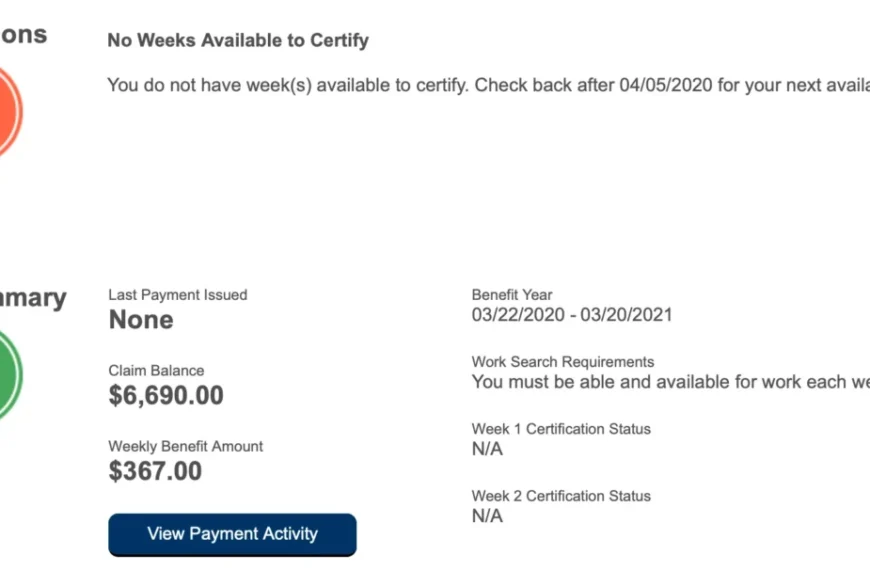
Does a Pending Claim Mean I Will Not Get Paid?
No.
A pending claim does not automatically mean that you have been denied.
It generally means that some part of the claim has not yet been completed or resolved.
For example, a state may still be determining eligibility or verifying information.
If the state later determines that you are eligible, it may issue benefits according to its rules and the weeks for which you qualified.
What Does “Pending” Mean on an Unemployment Claim?
A pending unemployment claim generally means that the state has not completed the processing or determination associated with your claim.
The specific reason can vary.
For example, the agency may need to:
- Verify your identity
- Review your wages
- Contact your employer
- Review your job separation
- Check another eligibility requirement
- Review information from a certification
California’s EDD, for example, says a pending payment can mean that an issue with the claim needs to be resolved and that identity or eligibility may need to be verified.
Other states can use different terminology and procedures.
What Should I Do If My Unemployment Claim Is Pending?
If your claim is still pending, do not simply wait without checking your account.
Check your unemployment account
Look for:
- Claim status
- Messages
- Notices
- Document requests
- Identity verification requests
- Certification information
- Payment information
Complete requested actions
If the agency asks for information, submit it through the official channel.
Continue required certifications
If your state requires weekly or biweekly certification, continue completing it according to the instructions.
Check your payment history
If your claim has already been approved, look at your payment information to see whether a payment has been issued.
Contact the unemployment agency if necessary
If your claim remains unresolved and you cannot determine why, contact the unemployment office for the state handling your claim.
What If My Unemployment Claim Has Been Pending for More Than 3 Weeks?
If your claim has been pending for more than three weeks, that does not automatically mean something is wrong.
However, it is reasonable to check whether there is an unresolved issue.
Start by checking:
- Your online unemployment account
- Official messages
- Notices
- Identity verification requests
- Certification history
- Payment history
- Requests for additional documents
If everything appears complete but the claim remains unresolved, contact your state’s unemployment agency.
Do not rely on an unofficial website or social media account for information about your individual claim.
What If My Unemployment Claim Has Been Pending for More Than a Month?
A claim that has remained pending for a month or longer may require additional attention, particularly if you have received no explanation.
Check your account carefully for an unresolved issue.
Possible reasons can include:
- Identity verification
- Employer response
- Wage verification
- Eligibility investigation
- Missing documentation
- Certification problems
- Another issue specific to your claim
The exact reason cannot be determined simply from the word “pending.”
If the state has requested information, respond as soon as possible.
If no request is visible, contact the appropriate unemployment agency.
Can You Get Back Pay for Unemployment?
Whether you can receive benefits for earlier weeks depends on your state’s rules and whether you were eligible for those weeks.
Do not assume that a delayed approval automatically means every week will be paid.
You may need to have completed the required certifications for the relevant weeks.
For this reason, keep track of your claim, certification dates, and communications from the unemployment agency.
Does Filing Unemployment Take Longer If You Were Fired?
It can.
If you were fired, the state may need to review the circumstances surrounding the termination before determining eligibility.
This does not mean that every person who was fired is automatically ineligible.
The unemployment agency may request information from you and your former employer before making a determination.
Provide accurate information about what happened.
Does Filing Unemployment Take Longer If You Quit?
It can.
Voluntarily leaving a job can create an eligibility issue that requires additional review.
The state may ask why you left and whether the circumstances meet its unemployment requirements.
Do not change the reason for leaving your job to try to speed up or improve your claim.
Can Working Part-Time Delay Unemployment?
Working while claiming unemployment can affect your claim depending on your state and the amount of income you earn.
Many unemployment programs require claimants to report earnings.
If you work part-time, report your wages accurately according to your state’s instructions.
For example, California’s EDD states that claimants must report earnings and that working part-time may still allow reduced benefits in some situations.
Does a Waiting Period Affect the First Payment?
Some states have a waiting period before unemployment benefits become payable.
The rules are different by state.
For example, California currently requires a one-week unpaid waiting period on a new claim before payment, provided the claimant meets the applicable requirements for that week.
You should therefore check your state’s current rules rather than assuming that every state handles the first week in the same way.
How Can I Make My Unemployment Claim Process Faster?
You cannot control every part of the unemployment review process, but you can reduce avoidable delays.
Provide accurate information
Check your application before submitting it.
Make sure employment dates, employer information, wages, and other details are correct.
Respond quickly
If the state requests information, respond as soon as possible.
Complete certifications
Do not miss required certification deadlines.
Monitor your account
Check your unemployment account for new messages and notices.
Use official websites
Avoid third-party websites that claim they can process or speed up your unemployment claim.
Is There One Unemployment Processing Time for All States?
No.
There is no single nationwide approval timeline.
The U.S. unemployment insurance system is administered through separate state programs. Each state establishes its own eligibility rules and administrative procedures.
This is why an unemployment claim can be processed differently in California, Texas, Florida, New York, or another state.
Frequently Asked Questions
How long does unemployment take to get approved?
The timeline varies by state and individual claim. The U.S. Department of Labor says the first benefit check generally takes about two to three weeks after filing, but claims requiring additional review can take longer.
How long does it take to get the first unemployment payment?
For many claims, the first payment can take around two to three weeks after filing, but there is no guaranteed timeline for every claimant.
Why is my unemployment claim still pending?
Your claim may be pending because the state is reviewing your identity, wages, employment separation, eligibility, or another issue.
Does pending mean my unemployment was denied?
No. Pending and denied are different statuses. A pending claim has not necessarily received a final eligibility decision.
What should I do if my unemployment claim is taking too long?
Check your online account for messages, document requests, identity verification requirements, certification issues, or other actions. If you cannot identify the reason for the delay, contact your state unemployment agency.
Can I get unemployment back pay if my claim is approved late?
Possibly, depending on your state’s rules, eligibility, and whether you completed the required certifications for earlier weeks.
Does unemployment take longer if I was fired?
It can if the state needs to review the circumstances surrounding the termination.
Does unemployment take longer if I quit?
It can because voluntarily leaving employment may require an eligibility review.
Can I work part-time while waiting for unemployment?
Depending on your state and circumstances, you may be able to work part-time and still qualify for some unemployment benefits. You generally need to report your earnings accurately.
How Long Should You Expect to Wait?
For a straightforward unemployment claim, two to three weeks is a useful general expectation for the first payment, based on U.S. Department of Labor guidance. But it is not a guaranteed approval or payment deadline.
If your claim remains pending beyond that period, check whether the unemployment agency needs information from you.
The most common areas to check are:
- Identity verification
- Wage information
- Employer information
- Reason for job separation
- Certification
- Additional documentation
- Other eligibility issues
Because unemployment insurance is administered by individual states, always check the rules and claim information for the state handling your application.
Disclaimer: This article is for general informational purposes and is not legal or financial advice. Unemployment rules, processing procedures, waiting periods, and payment schedules vary by state and can change. Always verify current information with your official state unemployment agency.
 By
By